A Church in the City with the City in its Heart

The past three years I have had the opportunity to work with a group of folks at Maple Avenue Ministries as a volunteer facilitator for its leadership team. It’s been a joy to be with others who believe that what seems impossible by earthly measures can happen and who expect God will act. The congregation has courageously demonstrated over its history its strong desire to be a place of love and care for its neighbors, those down the street and across the city. It is one of the most unique places of ministry in this city of churches because it manifests what heaven will be like - multi-ethic, young and old, beautifully diverse, and seeking to live out a mission of caring, connection, and commitment.
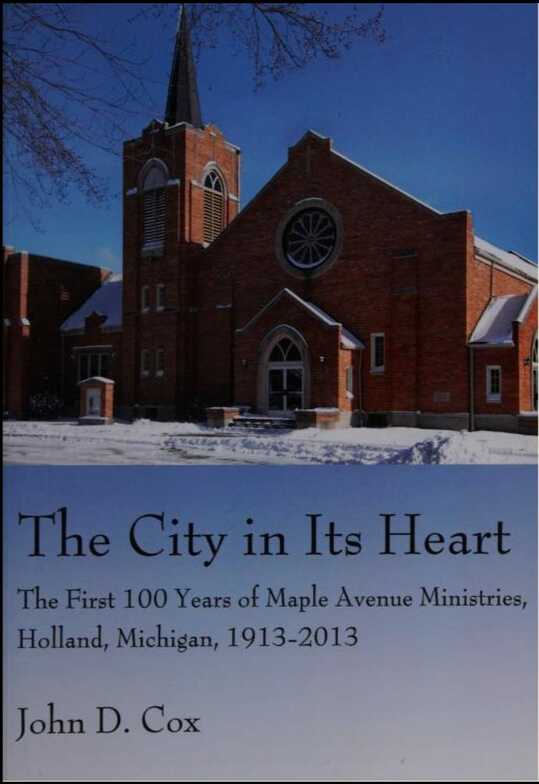
I kind of stole the title for this article from Dr. John Cox, retired Hope College English professor and author of the history of Maple Avenue - The City in Its Heart. If you would like to read this book, it is out of print, but available here to borrow and read online.
I asked John recently to share a brief history of Maple Avenue and why its people call themselves the affectionate term “Mamily.” Below is what he wrote about this special place.
What we now know as Maple Avenue Ministries began its existence in 1913 with the encouragement of Peter Hoekstra, pastor of 14th St. CRC. He inspired some of his parishioners to establish a new ministry in the expanding population on Holland’s west side. The new church was not only geographically adventurous but also followed the example of its founding church in making English its default language, thereby becoming just the second congregation of CRC Classis Holland to do so. The choice to minister in English identified the new church implicitly with the dominant U.S. culture rather than with the immigrant Dutch culture that had founded Holland in 1867. Moreover, Maple Avenue CRC reached out to the Dutch Reformed Church in America by purchasing its first building from Fourth RCA. This was a wooden building, which was lifted and moved intact from Fourth St. to the northwest corner of 18th St. and Maple Ave, where it was oriented with its pulpit to the north and its main entrance to the south on 18th St.
Maple Avenue CRC initially flourished as a traditional meeting of Christian Reformed believers. Until after the end of World War II in 1945, the congregation’s most noteworthy leader was Daniel Zwier, the church’s longest serving pastor (1920-1945). Zwier led during the most various period of Maple Avenue’s history: the economic boom of the 1920s, the Great Depression of the 1930s, and the challenges of World War II.
After 1945, as the church’s neighborhood began to change, traditional congregants abandoned the area and the church in the 1950s and 1960s, precipitating a worrisome decline in membership. Nonetheless, Maple Avenue CRC took a momentous step in 1952 by constructing a new brick building. Initially, this was to have been erected in a new location, several blocks south, but the decision was eventually made to demolish the wooden building on Maple Avenue and 18th St. and to build anew in the same location. The brick building was oriented at right angles to the wooden one, with its entrance to the west, on Maple Avenue.
As membership declined, four pastors in the late twentieth century were particularly influential in maintaining hope and momentum. Eugene Bradford (1974-1980) encouraged the congregation to rethink its identity by reaching out to its changing neighborhood and by adding nonconsistory members, including women, for the first time to church committees. Eric Gray (1995-1999) was Maple Avenue CRC’s first Black pastor. He was ordained in the Christian Reformed Church in 1998 as the first African - American pastor in the Christian Reformed Classis Holland.
Peter DeHaan (1991-2005) initiated weekday use of the church’s large parking lot for supervised neighborhood recreation (MAC-REC) and formulated a mission statement: “It is the vision of Maple Avenue Church to be a fellowship that serves the community.”David Sieplinga (1996-2003) was the most innovative of the four late twentieth- century pastors. He emphasized nurture of the congregation in order to provide for outreach to the community. MAC-REC carried on and flourished. Eric Gray, who remained at Maple Avenue as associate pastor, led Holland Teen Ministries. David Kool, who had been instrumental in Sieplinga’s call, pursued an initiative called Jubilee Ministries, which combined several projects under the concept of enabling people to help themselves, from healing broken families to creating employment for core city young people. Sieplinga proposed a new name for the church’s broadening conception of itself, “Maple Avenue Ministries,” to exist alongside Maple Avenue CRC, which continued to be pastored by Peter DeHaan. Sieplinga saw Eric Gray’s presence as crucial in transforming MAM into a multi- racial outreach, and he soon hired C. J. Grier to be minister of music. Grier reached out to young people in particular and led singing groups from Maple Avenue on international tours, including Europe, Japan, and South Africa.
As time progressed, it was evident that Maple Avenue Ministries was rapidly outgrowing its mother church, so David Sieplinga proposed that the two entities be separated. An earlier Sunday liturgy would be provided for the remaining CRC members, with Peter DeHaan presiding, and the main service would be later, with distinctive music and Sieplinga himself presiding. For the second liturgy a screen was installed at the front of the sanctuary on which the words of praise songs were projected.
Sieplinga and Christ Memorial Church worked together to form a union church with Maple Avenue in 1998—that is, a congregation with formal membership in both the Christian Reformed Church and the Reformed Church in America. Maple Avenue thus showed the way for Pillar Church shortly afterwards to become a union church as well. This was a momentous development, since Pillar Church had been founded by A. C. Van Raalte, the founder of Hope College and of Holland, Michigan.
Maple Avenue’s first woman pastor was also the congregation’s second African-American pastor (after Eric Gray). Her name was Denise Kingdom, and she came to Holland originally to marry C. J. Grier, whom she had met when they were both undergraduates together at Shaw University in Raleigh, North Carolina. David Sieplinga married them at Maple Avenue in 1999. Kingdom-Grier soon felt called to Christian ministry, and in keeping with her background she applied to Grand Rapids Baptist Seminary. Timothy Brown, who was then teaching at Western Theological Seminary, reached out to ask her if she would consider applying to Western as well, so she did, eventually enrolling there and completing her MDiv. Maple Avenue was her first call, serving as minister of the Word along with her husband as minister of music. Maple Avenue was especially attractive to seminarians of color, who felt more comfortable ministering to a congregation where most members looked like them rather than like the majority population. In 2017-2020 Winfred Burns, a student at Western Seminary, served an internship at Maple Avenue under the mentorship of Denise Kingdom-Grier. In 2022, Rev. Burns accepted a call to become the full-time senior pastor of Maple Avenue Ministries.

-
Maple Avenue Ministries